Sunday, 28 June 2020

The Beginning of the End?

As we are all aware, the last few months have been frustrating and challenging given the ongoing disruption caused by Covid-19. However, as the restrictions are eased, all businesses are looking at how they might be able to restart at the earliest possible moment, and the GWsR has been no different. Despite the silence across our blogs and the cessation of services for an extended period, that does not mean that the whole of the railway has been inactive and this has been reflected in a number of things that have been occuring across the social media groups of the railway itself and the various owning groups. We have had regular updates on the main GWsR website and Facebook pages as well as Loco of the Day photo galleries on the 'Honeybourne Line' Facebook page aimed at keeping the profile of the line up, stir a few memories but also, with the Gotherington landslip repair, bring in some pennies.

A loco long returned to the mainline with COLAS as 37099, 37324 'Clydebridge' heads towards Bishops Cleeve light engine. Just in the background is the site of the, now repaired, landslip that was completed thanks to the generous donations that have been  made since the appeal went out just after lockdown. (Photo courtesy of R. Drewitt)
However, things have moved sufficiently to allow a much more focussed look at re-opening and, if you have been on Social Media over the last week you will have seen the bulletins stating that an emergency timetable will allow a resumption of services on the GWsR. That doesn't mean that things return to normal immediately as there are still restrictions that have to be complied with, but it allows the railway to start earning revenue again. The crucial date is Saturday 15th August, the day we see a return to action - albeit, heavily regulated and restricted. Tickets will only be available for one round trip and you can only book at certain times. We will be running one steam- hauled service, using a rake of six coaches consisting of four compartment or 'composite' and one 'open' coach (along with a half brake) and there are restrictions on what you can book and with minimum numbers. For the full details as they come together, see the GWsR Website page HERE. There will be no immediate diesel running, although, if there are sufficient bookings (or demand) then this may well be re-assessed.

It also means that, in the not too distant future, we can get back to maintaining and restoring the fleet. However, again, details are still being finalised to work alongside current restrictions but certain elements can now be undertaken to ensure that, when given the call, our serviceable fleet can be put into traffic quickly. One of the more essential jobs that need to be carried out is to add an anti-bacterial additive to the diesel tanks of all the locomotives. Over time, bacteria from condensation can cause the diesel to become contaminated and cause serious running issues. With the weather conditions we have had over recent months (cold and wet - mild and dry - mild and damp) and the locomotives standing idle, the conditions allow for the ingress of condensation and the breeding of bacteria in an, almost, perfect environment. There is also some recallibration of air pressure systems required due to the locos having not moved since March, if not before.

The enforced shutdown has, of course, affected the restoration of 1693 (or 47105). Here she is in positively Baltic conditions at Toddington Yard c.2010. (Photo courtesy of R. Drewitt)
Sadly, though, the reopening does not allow us to reinstate the Diesel Gala for 2020 so, the organisers have been working with the GWsR Social Media Team looking at other options for the weekend of July 25th and 26th that would allow us to show off our fine fleet in a digital way. This has culminated in a Virtual Diesel Gala that will take the place of the real thing for this year. Details are still being ironed out but it is hoped that it will include opportunities for 'visitors' to learn more about our fleet of mainline locomotives, shunters and DMUs as well as see how diesels shaped the later years of the line up until final closure and dismantling in 1979 but also its resurrection. There will also be auctions of a variety of bits and pieces and, if restrictions will allow, the potential for interviews and virtual locomotive walk arounds....the nearest we can get at present to allowing the public to get up close and personal! Many other heritage lines have done something similar - as has the GWsR with the Steam Gala back in May. Keep an eye out for further details and lets make it a a good event.

More details will follow in due course.   

In the meantime, some more pictures of years gone by and a quick look at two locos that have called Toddington home. Firstly, Paul Jones, a regular contributor of pictures to the blog and also co-owner of one of our shunters, has passed me a couple of photos of the day that it arrived. 'DES' has been a fixture in the yard at Toddington for a good few years and has returned to service in the last year after having been out for a long spell having its centre axle rebuilt.

372, as it was then known, is captured heading up the M5 from its former home at Allied Steel and Wire, Cardiff. (Photo courtesy of P. Jones)

372 is prepared for unloading onto the rails in Toddington Car Park. (Photo courtesy of P. Jones)
372 sits in front of the Goods Shed, now machine shop, in Toddington Yard. (Photo courtesy of P. Jones) 
In the mid 2000's a number of Class 08 shunters were based at the GWsR in a variety of different colour schemes. This included 08881 or D4095, depending on whether you are pre or post TOPS. Built in 1961 it was based through its entire BR life in Scotland, being withdrawn from Ayr TMD in 2004. It arrived for the first of its three spells at the GWsR in 2007, before being released for spot hire to Lafarge, Mountsorrel for a period in 2008. It returned late in 2008 before being sold to the Somerset and Dorset Railway Heritage Trust at Midsomer Norton. It returned on hire in 2013 for a year to cover a shunter shortage at Toddington before heading back to the S&D. The following photos of 08881/D4095 are courtesy of Richard Drewitt and were taken in 2008 and 2013.


D4095 rests in the sun at Carriage and Wagon, Winchcombe. (Photo courtesy of R. Drewitt)

D4095 sits on the unloading road at Toddington. (Photo courtesy of R. Drewitt)
Its not just some of our ex-mainline locos that have been recalled onto the national network (37324/37099 and 37219 are ex-residents that are now with COLAS) but one of the Class 08 shunters that were based at Toddington has also returned to revenue earning service on the mainline. 08683 was only based at Toddington for a short period in 2010 having been purchased by Rail Support Services (RSS). Whilst at Toddington the shunter still wore its faded EWS livery of maroon and yellow.

08683 at Toddington in charge of a demonstration freight. (Photo courtesy of R. Drewitt)

08683 basks in the sun at Toddington (Photo courtesy of R. Drewitt)

Back with the brake van. (Photo courtesy of P. Drewitt)
The Class 08 now wears the smart RSS dark grey livery and is currently based at Norwich Crown Point T&RSMD.


Saturday, 18 April 2020

No work and no play......

Nearly four weeks into the Covid-19 lock down and the world is very odd place! Having to adapt to a very unusual set of circumstances has put a lot of people, myself included, into situations that we would never have envisaged in a month of Sundays. With us all being told to stay at home the fleet has been isolated as well and no work has been allowed to be conducted. So, what to do with the blogs?

We are very lucky within the department, and in the wider GWsR community, to have a number of volunteers who have a huge array of photographs obtained either through their own photographic talents or through gifts or purchases. Having been a volunteer for a relatively short 7 years, I always find it fascinating to look at photos from 'the archives' so, for this tome, I thought I would ask around to show off some photos from fellow volunteers of the locos of years past as well as some of the current fleet at the GWsR in earlier guises.

Special thanks to Dean Tabor and Andy Smith for allowing me to use these pictures.

Firstly, we have a loco that has returned to capital traffic since its time at Toddington. 37099 arrived at the GWsR on the 18th April 1999 after withdrawal from Transrail in 1997 and purchase by a private individual. The loco was placed into custodianship of The Growler Group and work started on returning it to a former guise in BR Blue as 37324 complete with its 'Clydesbridge' nameplates - a number it wore when allocated to Motherwell TMD as one of its Ravenscraig metals pool. Here are a trio of pics from Dean Tabor on the day of its arrival at Toddington - still wearing the Civil Engineers 'Dutch' livery.

37099 (37324) arrives on a low loader from its first, brief, home on the North Norfolk Railway. (Courtesy of D. Tabor)
Easy does it! (Courtesy of D. Tabor)
Safely on the rails again at Toddington. (Courtesy of D. Tabor)
The loco stayed on the railway until March 2013 when it was moved to the East Lancs Railway. It stayed there until 2016 when it was purchased by Colas, reinstated to mainline traffic as 37099 and renamed 'Merl Evans 1947 - 2016'.

Next up we have a few pics from Andy, a Guard and Duty Ops Officer on the GWsR, showing a couple of the current fleet in action as well as a couple of long departed locos from way back in the mid-1990s.

Class 31, D5541, arrives at Winchcombe in March 1996. (Courtesy of A. Smith)
Brush Type 2/Class 31, D5541 (31123 under TOPS) was withdrawn from BR stock in 1992 and arrived at the GWsR sometime in 1994 being repainted into BR Green and having its 'D' numbers reapplied. Sadly, the loco only saw a few years service before a serious engine failure saw it being sidelined from 1997 for a number of years whilst repairs were discussed and planned. They were to never happen and the loco was sold to the A1A Group as a spares donor for 37271 and 31418. The loco was finally cut up in 2006 at Booth's.

Class 20, 20137 passes the site of Hayles Abbey Halt in August 1995. (Courtesy of A. Smith)
EE Type 1/Class 20, 20137 arrived on the GWsR at some point in 1994 having been withdrawn from BR service in December 1992 and purchased by a private individual. Initially running in its final BR guise of Railfreight Grey with Red Solebar, but minus its 'Murray B Hofmeyr' nameplates, the loco was eventually renumbered to D8137, repainted in to BR Green with small warning panels. It now resides in workworn BR Green with full yellow ends.

24081 heads through Dixton Cutting at somepoint in the mid 1990s. (Courtesy of A. Smith)
Another current resident, Sulzer Type 2/Class 24, 5081 (24081 under TOPS) arrived on the GWsR in 1995. The loco is a bit of a celebrity as it was the final representative of its class still in use by BR, not being withdrawn until October 1980 and then entering preservation immediately. 5081 is back in full service after its bogie overhaul and some electrical work.

One of three Class 14 'Teddy Bear' locos that have been based at the GWsR prepares to take the plunge in the yard at Toddington during March 1996. Class 26, 26043 is seen to the left, still wearing its 'Dutch' livery. (Courtesy of A. Smith)
The GWsR was once home to three Class 14 Hydraulic locomotives with D9537, D9539 and D9553 all arriving during the early 1980s and being the mainstay of diesel services during the early years. The final example to be based at Toddington was D9553, which was privately owned, moved to the Vale of Berkeley Railway in 2016 having last run in 2009.

Photographic contributions of the fleet, past and present, as well as diesels on the line prior to 1976, are always greatly received. If you want them to appear in a blog (or in an eventual book/brochure) then email them through to me, with details, at g_arlett@hotmail.co.uk

Finally, the GWsR is still running a fundraising campaign so that the major landslip between Gotherington and Bishops Cleeve can be fnished. At last count the amount raised stood at around £165,000 of the £250,000 needed to complete the work. If you would like to donate to this or to help with the railway's finances during lockdown, then click here to go to the GWsR website.

Stay safe.


Tuesday, 24 March 2020

Lockdown!

As we all have probably heard the country is pretty much on lockdown and this is, sadly, no different now at the GWsR. Not only have all services been cancelled but access is now restricted and so no work can be conducted on the locos until furhter notice.

Lucky, then, that the last weekend was captured in some form. Special thanks goes to Alex Raybould who provided a brief overview and a number of pics to mark the last working day before shutdown.

First up, work was continuing on Class 26, D5343 and its leaking engine components. Having had the cylinders removed earlier in the month it was now the time to park the McRat under the gantry crane and lift out the liners. In a 12 or 16 cylinder loco this can be a really difficult task due to the clearances involved but the Class 26 has a 6 cylinder engine and a large roof hatch. This gives a reasonable amount of space to work in.

Andy, with the aid of the overhead gantry, eases a cylinder liner out of the Sulzer 6LDA28-A engine. (Courtesy of Alex Raybould) 
 Outside the loco the conditions were much more inviting!

Under a watchful gaze, and in some nice spring sunshine, Tony eases another liner to earth. Simon casts a quick glance over the first two to be removed. (Courtesy of Alex Raybould)
Elsewhere, the ongoing restoration and overhaul on Class 47, 1693 passed a major milestone. After putting bits and pieces back together you always wonder whether it will still work. I remember the anticipation and nervousness of watching D6948 fire up for the first time after its resotration! 1693 was also dragged out into the sunshine so that this could happen (hopefully the vid works! Courtesy of Alex, again).....

1693 is allowed outside to enjoy the sun. (Courtesy of Alex Raybould)


According to Alex this was the 3rd start up for 1693 and, judging by the video, everything has gone to plan. Certainly sounds like a Class 47! For Alex, it wasn't all photos and videos. He, along with Harrison (another graduate from our Youth Group), got to clean some of the older rocker heads. A great job when the weather is warm but not so much if its chilly!


(Both courtesy of Alex Raybould)
What will happen from here is anyone's guess. Hopefully things will rectify quickly and we can get back to maintaining nd running these fine locos.

As an aside, the enforced shutdown means that some of our capital projects have had to be put on hold. One of the major works ongoing through the shutdown is the repair to the major slip at Gotherington. With no money being generated it means that the railway is short of the final sum to complete the work. An emergency appeal has been put out on the GWSR web page and on social media asking for help. You can get more information of the appeal here. Every little helps, as they say!


Saturday, 21 March 2020

'This town is coming like a ghost town'....

....so went the lyrics to the Specials' song 'Ghost Town' and the last few weeks have certainly seen the railway become a bit eerie due to the ongoing Covid-19 outbreak. However, things had got off to a fairly bright start to March in the Diesel Department and, heavy maintenance work is continuing despite the fact the railway has decided to suspend passenger operations for the foreseeable future.

One of the biggest events during the early part of the month is the Cheltenham Festival services. Although no diesels are utilised on services it doesn't mean that there isn't the odd appearance of members of the fleet being utilised on other work. This was certainly the case on the Saturday of the Cheltenham Festival where Class 73, E6036 made an appearance at Winchcombe during the Growler Group AGM on the 14th March. The ED was being utilised to move empty stock around and had brought the 3rd rake to Winchcombe from Toddington under the control of Neil C.

E6036 arrives at Winchcombe on an ECS.
The ED pulled into Platform 2 before pushing the rake back into the Engineers Sidings. In the picture below, the loco has not propelled back through a signal at Danger. The entrance to the yard is controlled by ground disc. Class 37, D6948 had been utilised earlier in the week to bring the stock up from Winchcombe.

The ED pushes the 3rd rake back into the yard.
Work also finished on our resident Class 26's cab corrosion repairs and repaint at the end of February however, whilst being checked over for its visit to the Somerset and Dorset at Midsomer Norton, a serious engine issue was found that would require more substantial work to be carried out. D5343 had also been announced as a guest for the Severn Valley Railway gala but this new found issue meant that this was quickly cancelled (Class 24, 5081 was agreed as a substitute but Covid-19 has put paid to that event, along with many others in preservation). On running the engine up a leak was found in the liner seals of the cylinders. This can lead to engine failure so the owning group took the early decision to remove D5343 from traffic completely in order to remove the cylinders and rectify the problem.

It could almost be Haymarket TMD in the 1960s.....well, maybe not! 5310 and D5343 in the yard at Toddington in 2020.

D5343's 6 cylinders are laid out on the floor of Toddington Diesel Shed after removal.
With this issue now identified it is likely that the BRCW Type 2 is likely to be out of traffic for most of the year.

Toddington's other Class 26, 5310 on extended visit from Llangollen, inches closer to a return to its home base in mid Wales. With 'Shunty' (Class 04, D2280) having finished its stint on the jacks the Traction Motors that had been removed from 5310 for refurbishment were ready for refitting. In early March the loco was shunted back into the David Page shed so that it could be lifted and the motors resited on the bogie frames.

The intrepid GWR/Llangollen Diesel team that worked on the refitting of 5310's Motors. (Courtesy of the GWsR Facebook site)
Its a shame that, despite its extended stay at Toddington, 5310 won't run on GWR metals, with D5343 now out of action and the railway closed the intended double header to celebrate the class' 60th birthday will not happen. The loco will be returning to Llangollen in the near future, when transport can be arranged.

As mentioned, 'Shunty' or D2280 has come off the jacks and now sits in the yard. Bodywork repairs are in full swing as can be seen with the cab in primer and the engine doors stripped back to metal. 

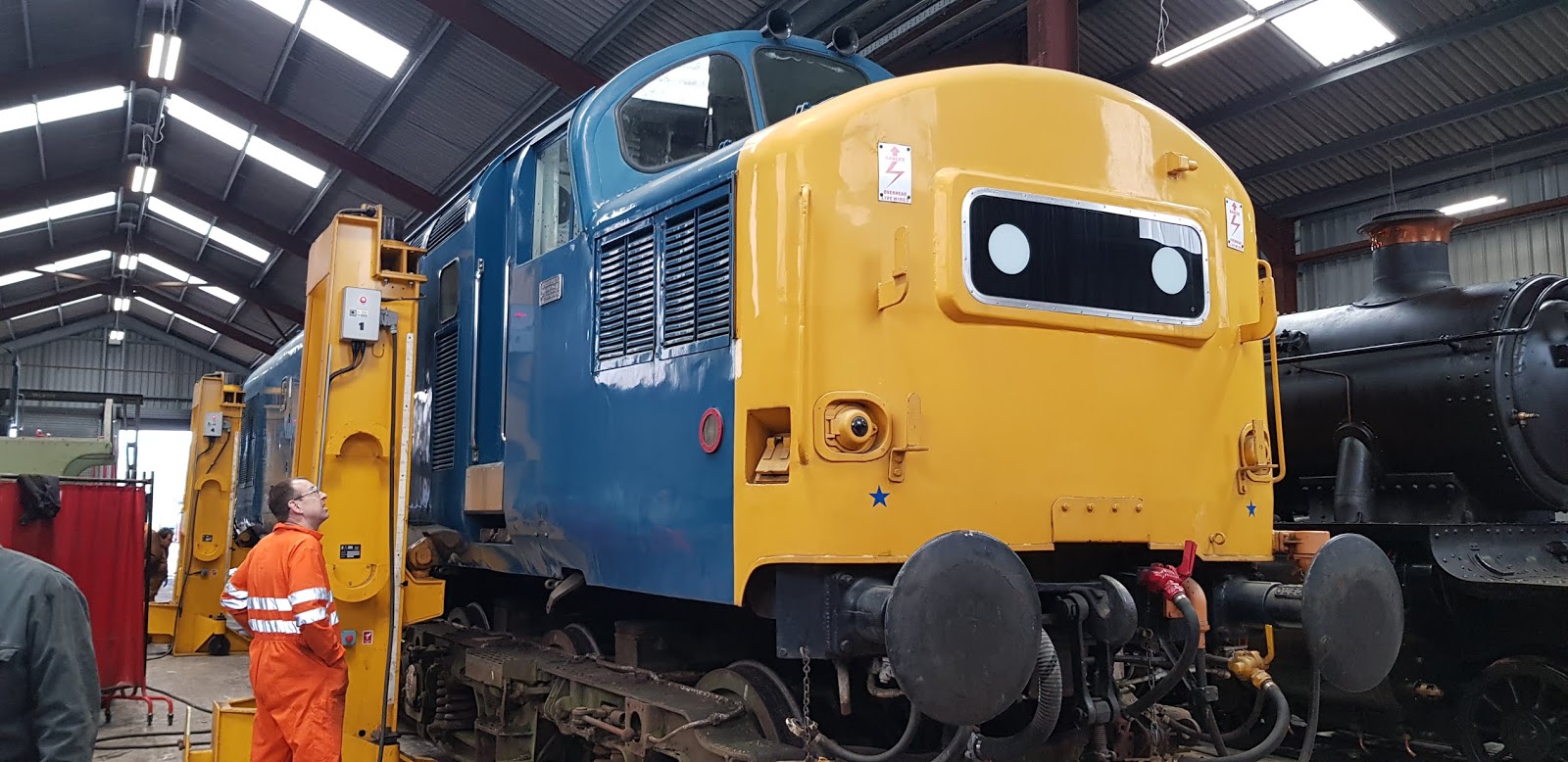
With the lifts for both D2280 and 5310 finished the next big job requiring the jacks was to lift Class 37, 37215, and return it to its refurbished wheelsets. The work on the Traction Motor bushes, dampers and the tyre re-profiling had been completed and it was time to get the loco back on its own bogies. The dates were set for the 18th and 19th March and a group of 8 of us descended on Toddington early on the Wednesday morning to conduct the work. Not only was the loco to be lifted, the accommodation bogies needed to be removed before the loco's original bogies were resited, the loco lowered, brake blocks changed and then all the electrical connections reinstated....all in 2 days!

Wednesday is usually a very busy day. However, with the Government advice being to stay at home and prevent too much social contact and, the railway having abandoned services for the foreseeable future, the yard was incredibly quiet! Eerily so! Under the guidance of Growler Group Chairman and Technical Director, Paul Good, we set about getting the loco into the shed and the jacks into the correct positions. This is a precision job which, if not conducted accurately would end up with a serious incident. The jacks had been purchased from BR a number of years ago by the Diesel Department for use by the Motive Power department and had been refurbished in order to allow big lifting jobs to be undertaken in house. Over the last couple of years they have been worth their weight (pun intended!) having lifted 5081, D8137, 5310, D2280, DES and now 37215 with D6948 waiting in the wings.

Class 37, 37215 is shunted into position in the David Page shed.

The jacks are moved into a rough position ready for the lifting brackets to be placed on the loco. 
With the loco shunted in to the David Page shed the lifting gear was prepared ready for the raising of 37215 off its accommodation bogies. In order to lift the loco, a set of brackets need to be fitted to the specific lifting slots which are then secured to four synchronised jacks. The lifting brackets being used were very kindly loaned to the Growler Group by the SRPS at Bo'ness. A very big thanks to all at the SRPS.

The lifting jacks loaned to the Growler Group by our friends at Bo'ness. These attach to lifting points on the loco body before being secured to the jacks. 

With the lifting brackets attached to the loco and the jack, everything can be lined up and the pins put into place. 
With the brackets lined up and pinned, the lifting can begin.
With brackets in place, the jacks were man-handled into position before Paul checked to make sure everything was in the right place before the slow process of lifting the loco skyward could begin. All 4 jacks are synchronised therefore being able to lift together, at the same rate, from one control panel. With Mark S manning the panel, instructions were given to start the lift. It is always a heart in mouth moment as you are moving 50-60 tonnes of locomotive into the air.

Dan keeps an eye on no.4 jack as it raises 37215 skyward.
The loco is inched off the accommodation bogies.

Ever wondered what the bottom of a Class 37 looks like?
Once the jacks hit 16 feet it was time to stop the jacks and prepare to roll the bogies out from underneath. But, first, one of the most important things of railway life comes first.....

....did someone say TEA?!
After a brief stop to replenish energy it was back to it. The next order of business was to move the accommodation bogies out from under the loco before moving the refurbished set back underneath the loco. This bit needed the manpower as the bogies would have to be manually pushed from under the loco body. At 20 tonnes a piece this was no easy feat. Once clear of the loco body and jacks, the forklift could then be used to move them to the front of the shed where Class 04, 11230 could take the bogies back into the yard for storage.

'Who's going to push it?'

With the 2nd bogie also clear the forklift, driven by Ian C, is hooked up to drage the 2nd bogies to the front of the shed. 

Mark S, in control of 11230, gingerly pulls the accommodation bogies down the yard. 
Whilst the bogies were being repositioned down in the headshunt siding Dan and I started the final preparations on the refurbished wheelsets back in the diesel shed. The final bits needed to complete the bogies for refitting centred around cleaning up and greasing the required friction points and adding copious amounts of Copa-slip to resting points.


When lowered, the loco body rests on a centre bolster with four friction points on each bogie - two front and two back that allow the loco and bogies to swing to take corners. Above, is one of the friction pads showing the shock absorber (centre right, a rubber pad with a metal sheet on top) with the cap (bottom, centre left). The bottom of the cap is greased before being placed on the pad. The loco body then rests, lightly, on the metal plinth.

Day 1 finished with the Copa-slip being applied to all the friction points.

One of the mounting points with Copa-slip applied.
Day 2 was even more quiet. As with Wednesdays, although quieter in the yard, there would usually be services running with cars and coaches all over the car park. But, with everything suspended it was even more noiseless than Wednesday. First order of business was to ready the bogies to be moved from the diesel shed to under 37215. One of the jobs needed doing was to clean and lubricate the bush covers to be refitted when bogies were back under the loco. A quick run over with a wire brush and then to lubricate the pin that holds it in place.

One of the traction motor bush covers.
Whilst cleaning the covers Mark S had fired up 'DES' and had entered the shed to transfer the bogies from the diesel shed to the David Page shed.

'DES' is hooked up to the first of the two bogies. John, Mark S and Paul oversee the movement.
Once the bogies had been carefully manouvered into the David Page shed, the forklift was fired up once more to assist in pushing the bogies back into position under the loco. Again, precision was paramount so that the underframe of the loco, or the bogies, would not sustain damage when the loco body was lowered. With the bogies in situ and as accurately positioned as possible with the naked eye, the loco body was cautiously lowered.
John G keeps watch as 37215 is carefully lowered. 

Nearly there!

TOUCHDOWN!
With the loco back on its own wheelsets it was dragged forward slightly over the pit so that work could get started on replacing the brake blocks and reprofiling the brake rigging. Working in pairs, Andy, Dave, John and I started working on replacing all the brake blocks....24 per bogie and all have limited accessibility. A taxing job even for the most patient of people!

Head of Department, Andy, gets to grips with the brake blocks on a Class 37.

Cue cursing, swearing and bruised fingers!

Paul, John and Phil have a quick conflab about the brake blocks. 

'This is how hard you need to whack it!'
As the brake blocks were re-fitted I was following behind with Paul and Dave re-assembling the brake rigging and setting the slack adjusters. Paul, Mark and Dave also fitted some of the new bushes to the dampers and, with Phil, gave everything the once over to check that everything was in the right places. By the end of Day 2 the loco was back where she belongs in the Diesel Shed after a number of months in the yard. Next jobs include wiring the traction motors back up to the electrical systems, securing all the blower conduits and getting rid of the flies in the engine room! However, with no services running the urgency level for having the work completed has lessend slightly but it also enables the possibility of organising a test run without having to worry about affecting passenger service.

At the end of two very full on, but rewarding days, 37215, back where she belongs.