Thursday, 21 January 2021

Lockdown 3.0 - Who'd have thought!!?

Mid January and we are all, once again, in a lockdown situation meaning that anything railway related has been well and truly 'put on ice' - except essential work. This includes the checking of batteries and, because of the weather, ensuring the locos (particularly those outside) are not showing the effects of the bad weather and cold temperatures. 

Well, what to do in a blog that showcases.....well, not a lot. By this time we were hoping that D6948 would have been lifted and work could start on its bogie refresh and air leak repair, 1693 would have been ever closer to its repaint, D5343 would on the road to having its engine put back together and, for the DMU Gang, preparation would be well underway prepping the Class 117 for a week of early year running in March! Sadly, all of this has been pushed back and, having had our Motive Power AGM last weekend, the general thought is that we won't be running until the spring at the earliest - possibly around Easter. 

So…..we take a journey back in time, again. However, we look at two different 'Days Gone By on the Honeybourne Line'. Firstly, again, I extend my eternal thanks to Tom Cullimore and Nigel Black for giving their permission to share these fine pictures. 

Stop 1 is a trip back 51 years to 1970. The Honeybourne - Cheltenham line was still very much in use, primarily for freight or for diverted passenger and parcels workings. Northbound passenger workings that were due to be routed via Toddington, that were also booked to stop at Cheltenham Lansdowne (now Cheltenham Spa) station, would face an interesting reversal move out of Lansdowne station to Lansdowne Junction before picking up the Honeybourne route. However, south bound services, it seems, were never required to stop at Cheltenham Lansdowne. The first of two pictures from the collection of the late Bill Potter shows a working running south past Lansdowne station on the Honeybourne line. 
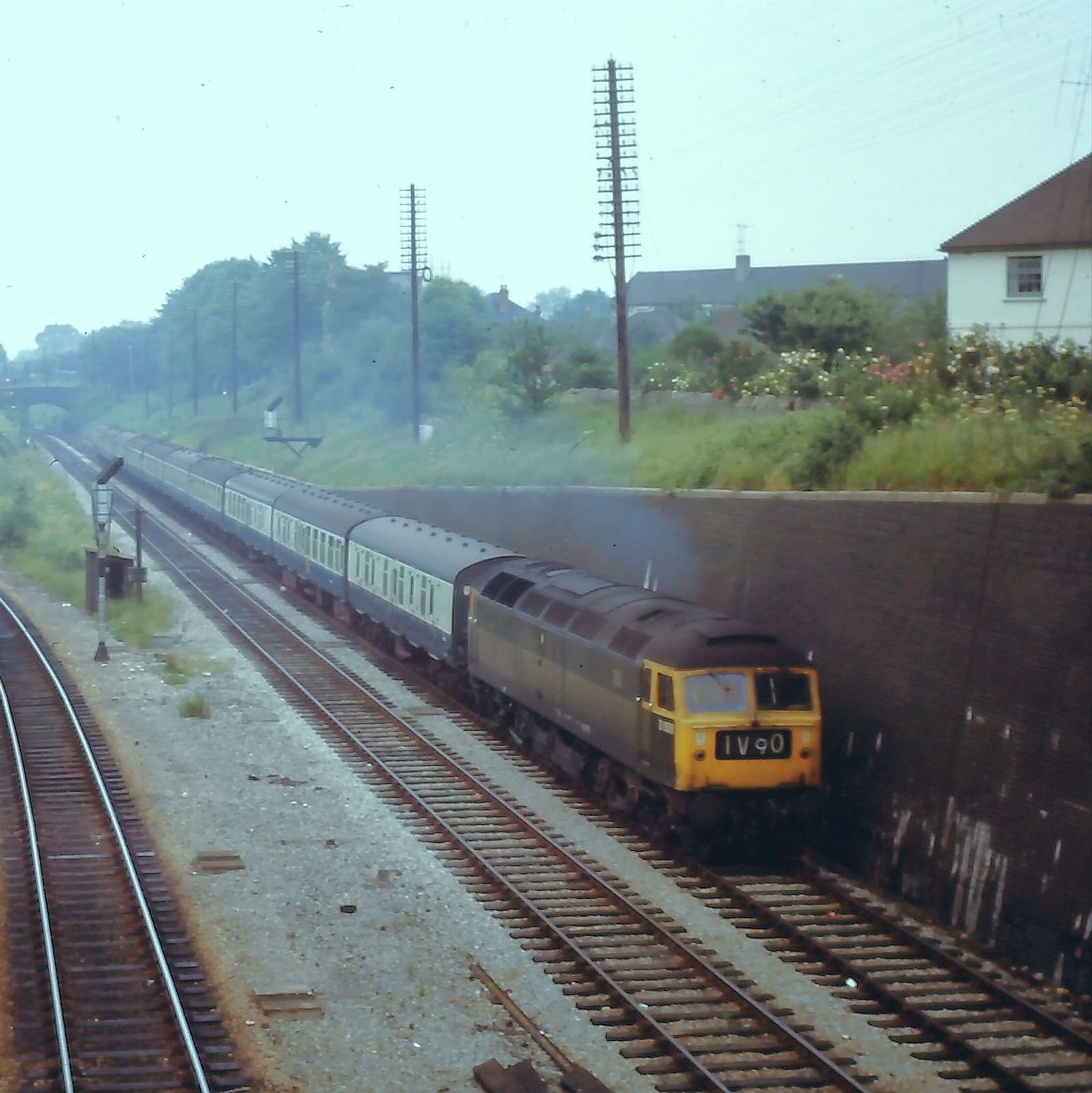
Brush Type 4, 1909, heads towards Lansdowne Junction, Cheltenham, on the 1V90 1430 Leeds-Plymouth which has been diverted over the Honeybourne Line. This is showing the line heading towards St. James station. To the left, the ex-LMS line starts to curve into Cheltenham Lansdowne (Spa) station. 12 June 1970. (Bill Potter Collection, courtesy of Tom Cullimore)

It is strange to see the tracks of the Honeybourne line seemingly well used and it belies the fact the route only had 6 and a half years left! In fact, you could say that they are in better nick than the ex-LMS route to the left! This area is now utilised as part of the station car park at Cheltenham Spa. 

1909 would lead a very long life in service. The loco was renumbered 5 times (1909, 47232, 47665, 47820 and 47785) and would carry two names as 47785 - 'The Statesman' and 'Fiona Castle'. It was delivered new to Cardiff Canton in 1965 and would see allocations to Gateshead, Glasgow Eastfield, Bristol Bath Road and Crewe Diesel, before being withdrawn in 2003. The loco was subsequently preserved and is now based at the Wensleydale Railway. 

The next picture is a little further up the line at Bishops Cleeve and gives a view that is very different to that we have today. 

Another Brush Type 4, 1727, this time in BR Blue, heads a Class 8 coal train past the what was to become the Royal British Legion and, more recently, a nursery at Bishops Cleeve. The loco would be approaching, what is now, the foot crossing into Woodmancote on the current line. 20 December 1970. (Bill Potter Collection, courtesy of Tom Cullimore)
 

 For those not well acquainted with the area, the picture shows a marked difference to how the area looks now. As we drive through there, modern housing has now encroached on both sides of the line, giving little clue to the railway infrastructure that was there. The site of Bishops Cleeve station can be identified by the ubiquitous Scots Pine trees in the background, above the rear of the train. It is also interesting to see that it appears that the signal box, sited on the 'down' side of the line, has been demolished. 

1727 was new to Old Oak Common in 1964 and would see subsequent allocations to Bristol Bath Road, Bescot, Immingham, Stratford, Cardiff Canton, Crewe Diesel, Carlisle Kingmoor, Gateshead, Glasgow Eastfield, and Toton, before being withdrawn in 2007. Like 1909, it would also be renumbered 5 times in its career - bearing the numbers 1727, 47135, 47664, 47819 and 47784. It was also named, as 47784 - 'Condover Hall'. 


Stop 2 sees us lurch forward in time to the fledgling GWR and the years 1993 and 1994. By this time, the railway had made great strides south and the line now reached Far Stanley. Cheltenham Racecourse was still a little under a decade away. The following photos are courtesy of Nigel Black who has been a mainstay of the P'Way Department at the GWR and, like Mr. Cullimore, was a regular loco spotter on the line in his youth. The photos below were all taken during Nigel's early volunteer years with the P'way department. 

One time resident, Class 50, 50021 'Rodney' heads past the site of Hayles Abbey Halt as it heads towards Winchcombe. It would be another 20 years before Hayles Abbey Halt would reappear on the railway map and, another 25 years before the sounds of an English Electric 16CVST engine were heard echoing through the Cotswolds. 1993 (Courtesy of Nigel Black) 


50021 was one of the first 'heavy' mainline locos to arrive on the line and was restored by a number of volunteers who would go onto form the early Diesel Department and, eventually, would become mainstays of the railway. 'Dave', as the loco was informally known due to references from characters in UK comedy Only Fools and Horses, would leave the railway in 1995 and headed to Bo'ness where she languished for a number of years. Bought by a private individual back in 2015 with the intention to return it to mainline use for railtours, the loco is currently undergoing a very thorough overhaul at Eastleigh. 

If ever a photo epitomised how the GWR has progressed, its this one. 50021 has arrived at Winchcombe, which still resembles a building site, with a southbound train. No second platform, no Carriage and Wagon shed extension, no footbridge, no station canopy! September 1993 (Courtesy of Nigel Black)


After the arrival of 'Rodney' there was a brief explosion of diesel loco arrivals to the GWR. Initially, the fleet included three Class 14s and a few shunters - industrial and ex-BR. However by 1994, the GWR was also to become home to a Class 20, a Class 31, a Class 37, a Class 47 and, of course, 50021. There was also the arrival of a DMU set. In these views from the 22 July 1994 we see how the diesel fleet had expanded somewhat. 

Class 31, 31123, and Class 47, 47105, out on test at Toddington shortly after arrival at the railway. Its evident to see the amount of parts robbing had occurred to the Class 31 between withdrawal and its preservation.  (Courtesy of Nigel Black)

Sadly, 31123 would not last long in preservation and would be out of service with a serious engine failure by 1997. Sold to the A1A Group, she was used as a spares donor for 31271 and 31418 before being cut up in 2006. On the other hand, 47105 is currently in the final throes of an 8 year overhaul and will hopefully see service again towards the end of 2021.


The Class 14s were a very popular addition to the diesel fleet, however, they would eventually end up being taken elsewhere by their subsequent owners. At this time, Toddington Yard was all open and any restoration work was done either in the open or in one of the small prefab sheds dotted around the yard. It would be another 12 years before the David Page shed was built, and 2012 before the diesel shed was built. In this line up we have Class 14, D9537 as well as pre-restoration 37215 and 20137. Behind them is a Class 108 DMU that was an early resident of the line. (Courtesy of Nigel Black) 


D9537 was one of three ex-BSC Corby Class 14s that ended up at Toddington. These Type 1 locomotives were built to carry out freight traffic on the Western Region that was in serious decline at the time and would only see around 7 years of service with BR before being withdrawn. Many would go into industrial use which would then lead to a high proportion being available for preservation. D9537 is now based on the Ecclesbourne Valley Railway. 37215 and 20137 (D8137), are still resident at the GWR and form an integral part of the fleet. 

Stay safe. 


Monday, 21 December 2020

The New Arrival

As mentioned in the last edition, the department received a new addition to the fleet on Friday 18th December. Class 20, 20228, safely arrived from the Barry Tourist Railway courtesy of SA Smith heavy haulage. 

Below is a number of photos taken by HoD, Andy Durham, of its arrival at Toddington....


A very happy owner, Steve Madge, oversees the safe arrival of the pristine looking 20228.

Touchdown! Safely on the unloading road ready for shunting into the shed.


The nose end showing the new marker lights. 

Safely on shed alongside the ED, another of Steve's machines. Sadly, E6036 is the one making room for 20228 and will be leaving for pastures new when the formalities are concluded. 


Man and one of his machines! 

For the record, the restoration of 20228 to this condition has been quite a journey. Whereas sister loco (also owned by Steve), D8137, was complete and a runner on arrival at the GWsR in the 1990s, 20228 was one of the Class exported for use with CFD in France. It was adapted and altered to meet French railway safety requirements, including having large headlight clusters sited on the solebar, as can be seen from one of my blog pictures of 20035, that was broken for spares, from a couple of years ago...

20035, another of the Class that was exported to France along with 20228. Luckily, 20228 wasn't in such a bad condition but it gives you an idea of the job that Steve and his team at Barry faced to get the loco looking line it had just rolled out of Doncaster Works!


It is hoped that the finished touches to outside of the loco will be done whilst the exhauster is away being overhauled, and that this will allow the loco to be fit to run for the beginning of the 2021 season. Sadly, D8137, is still undergoing its Traction Motor replacement, but it is hoped that at some time during 2021 both Class 20s will work together - as they would have done many times over the Honeyborne line under BR. 

If you have a Facebook account, you can sign in to watch a fantastic video by Road Pilots Abnormal Load Escort of the journey of the loco heading out of Barry on its low loader. The link is HERE.

Thursday, 17 December 2020

A Quick Update

Despite all the mystery around the new Coronavirus tiers and who can do what/go where, the past week has been full of little events that have seen the department move towards being ready for 2021. 

A few weeks ago, 1693 is shunted in the yard with 37215. 

Sadly, as I haven't been around, there are few picture (one of which has been craftily 'borrowed' from our C&W colleagues) but, Tuesday the 15th saw Class 47, 1693, escape the confines of Toddington yard and venture out on the line for a loaded test run along with sister loco, 47376 'Freightliner 1995' and 45149 as insurance/ballast. The weather was suitably clear to allow the convoy to do several runs up and down the line to check that everything was well with all the systems prior to its repaint, scheduled for early in 2021. Several members of the Brush Type 4 Fund had ventured up to crew, travel as fitters and to complete work on 47376's cab floor woodwork. It was pleasing to hear that everything went well with the test run and only a few small issues were identified. With things now in the final stages of its overhaul, it hopefully won't be long before we see 1693 back in rostered service. 

Pinched from the Carriage and Wagon Blog (sorry!), 1693, 45149 and 47376 pass Winchcombe on one of the test runs. (Courtesy of GWSR Carriage and Wagon Blog)


It has also been confirmed that the Department will see a new arrival on Friday, 18th December. No, nothing to do with the immaculate conception, but a new loco will be arriving as part of the home fleet. Steve Madge, owner of Class 20, D8137 and ED, E6036 also owns another Class 20 - 20228. This 'chopper' will be arriving to replace the ED which is off to pastures new in the future. Although not in running condition at the moment, 20228 has been resident at the Barry Tourist Railway since being returned from France where it was part of the CFD fleet. Whilst at Barry the loco has been returned to BR condition and has been repainted in BR Blue with its TOPS number but still requires an overhaul of its exhauster. It is hoped that both Class 20s will be in full service at some point during 2021 and will be able to work singly as well as in multiple.  

Elsewhere, work continues on Class 26, D5343 with a target set of being back in service at the beginning of the 2021 running season.  The lift of Class 37, D6948 has been scheduled for early January which will allow access to the underfloor air leak and will allow the bogies to receive the same attention as has been completed on sister, 37215. 37215 has been 'yard tested' to ensure that all systems are in working order prior to a test run being conducted. Prior to organising this the loco requires a new set of batteries and B Exam. 

Shunter, 11230 has been stopped with a starter motor issue whilst D2280 headed to Winchcombe, but I'm not sure why! There is the possibility it was heading to C&W to make use of the paint shop....however this is just supposition.  

The DMU fleet has also continued to receive various degrees of work and maintenance. The three car set has had its cycled exam and is now winterised as it is not being utilised on Santa trains this year. That being said, it will be the first to see action in the new year, all things being well, as the new operating year is scheduled to start nearly a month earlier with a period of DMU only running in February. The CDRL have secured a tarpaulin for Class 117 DMBS, W51372 whilst it waits its turn for refurbishment. The group are also looking to do a bit of winter prep on Class 107 DMS, Sc52059 and Class 117 TCL, W59505 to try and tidy up their appearance a little and to prevent any cold weather damage. The overhaul continues on Class 122, W55003, with more work ongoing with the door frames. 

It is unlikely that much will be ongoing over the Christmas period so, on behalf of the Department, Merry Xmas and stay safe.  


Saturday, 21 November 2020

Oh, for a time machine!

 As has been said many times before, we are lucky that there are a number of volunteers in the department (and across the whole railway) that can remember the later years of the line in BR ownership, and have photos that document this. 

One of those volunteers is a gentleman by the name of Tom Cullimore. Tom has been a member of the railway for a significant time and was a pioneering member of the early diesel groups, working on the restoration of 37215 when it arrived from Inverness TMD in 1994. Tom is also the owner of a huge number of photos, from his own and other collections acquired over the years, showcasing the 'Honeybourne Line' during the 1960s and 1970s. With the new Covid lockdown in full swing, with little to no work at Toddington, it was time to take a look back in time. Here are a trio of pictures, courtesy of Tom, from the collection of the late Bill Potter. 

All were taken at Winchcombe on a very sunny 24th May 1970.

BR green liveried EE Type 4 (later TOPS Class 40), D316, climbs out of the remains of Winchcombe Station towards Greet Tunnel with a southbound coal train. Class 40s were never really common in the South West but would work services to Severn Tunnel Junction and Gloucester. This loco became 40116 under TOPS and was withdrawn in 1983.

A picture that demonstrates that, even in the 1970s, the line was still regularly used for passenger diversions as well as freight. Sulzer Type 4 (later TOPS Class 45), 12, races past the goods shed at Winchcombe with a southbound express - probably from the North East. At this point the line speed would have been 70mph. This loco was to become 45011 under TOPS and was withdrawn in 1981.   

A little further down the line, this time at Prescott Road bridge, with some hazy sunshine permeating over the distant fields. Brush Type 4 (later TOPS Class 47), 1853, still wearing BR two tone green with full yellow ends, powers along with a coal train. Given the headcode, 8Z84, this would have been a special probably to meet extra demand. 1853 became 47203 under TOPS and was withdrawn in 1989. At the time of the photo it was based at Crewe (Stoke Division).

Bill lived in Bishops Cleeve and amassed a huge collection of photographs of the 'Honeybourne Line' stemming from the 1950s right through to closure. Many of these, particularly of steam on the line, are held at the Kidderminster Railway Museum. Tom regularly posts the diesel photos onto social media, so always a good excuse to keep an eye on all of the railway's social media outlets.    


Thursday, 5 November 2020

Lockdown 2.0 - The Revenge of Lockdown!

As I sit at my computer compiling this latest tome, Lockdown 2 has come into effect in England meaning that those of us that reside in England are now having to sit through new lockdown restrictions in the 'fight' against Covid. This has, of course, meant that operations across the railway have had to come to a halt again. Given that things had been going quite well at the GWR, the next month will see nothing but the most essential of maintenance work continuing and little/no revenue being generated - a real shame, as the public were still booking tickets for our restricted services in large numbers. It also means that all restoration and maintenance has to cease - except for critical work (this being designated by the Board on a case by case basis). With that in mind, the last few days have seen a flurry of activity in the Diesel Department. Over the past weekend there was a level of uncertainty as to what restrictions were being put in place so those in attendance were looking at getting maintenance and repairs to a point where they could be easily restarted when lockdown concluded. This led to quite a decent number of us at Toddington MPD on the Saturday with work continuing on 1693, D6948, D5343, 37215, 47376 and 45149. The weather was awful which meant that working under cover was a great relief with even D5343 being allowed in the David Page shed as work continued on the engine. 

D5343 invades the Steam Shed so that work on the engine could be continued out of the stormy conditions outside. 31/10/20

Simon T and Alex R were continuing the work on the engine overhaul. With the pistons and liners hanging in the Diesel Shed, work could be done on the drive shafts, fuel racks and injectors. Lots of checking and cleaning - looking for pitting, distortions and general wear. 


A view in to the prime mover of D5343. With the voids left by the removed pistons and liners, you can now start to work on other parts of the engine, including the drive shaft and fuel racks. 31/10/20

Once the weather had cleared up a little, Alex could then get on with pressure washing parts of the engine casing that had been removed for cleaning down. Using the pressure washer for cleaning engine parts is not a great job to do at the best of times as you get absolutely drenched, so, doing it after storm-force winds and rain doesn't make it any more enjoyable!

Evidence of the 'fun' Alex was having with the pressure washer! 31/10/20

A few odd jobs were also being completed on the 'Peak' ready for winterisation. 

With the clouds changing from dark grey to fluffy white, 45149 is shunted onto the apron for some minor jobs to be completed. 31/10/20 

This is the process of readying the locos ready for winter store - obviously this has been brought forward considerably due to the lack of running and the impending doom lockdown. The Peak and the Class 26, along with the Class 73 and DMU's, are very susceptible to the cold Cotswold winters due to them being stored outdoors. Winterisation generally includes draining water and other fluids that could freeze and expand, causing internal damage to components, and ensuring the antifreeze mix was topped up. 

In the Diesel Shed, Ian R and Dave M were continuing with bits and pieces on the overhaul of 1693. Dave was busy clearing around the bogie at No. 2 end ensuring that any paint or detritus was not preventing movement of the brake frames. 

The brake gear at No. 2 end on 1693 gets a clean up to ensure smoot running. 31/10/20

Meanwhile, Ian was busy with a few odd jobs around the door frames ready for the rehanging of the doors once top coat has been added. Each of the doors are in the process of being removed for the application of the undercoat, with the B Bankside cab doors removed. 

One of 1693's cab doors sits on a trolley wearing its new undercoat. 31/10/20

A little later Dave and Ian moved on to sister loco, 47376 'Freightliner 1995' which is suffering with some rusting under the cab flooring. With the cab floor ripped up in No. 2 end, the banging and scraping heralded the start of removing some of the rust to assess the scale of the remedial work to be carried out. 

Elsewhere, Mark S was busy within the engine room of 37215 as the process of returning it to service were continuing. After having reconnected all the electricals between the Traction Motors and Generator, it was time to make sure that all the components, circuits, relays and fuses were still functioning correctly. If any faults were found then these were either being corrected by Mark, as he went along, or would be relayed back to Technical Officer, Paul Good. It did flag up an issue with one of the compressors failing to fire up that would need further investigating. 

Steve M was also milling about doing some investigative work on Class 73, E6036, which has developed an issue with one of its suspension systems. He was also taking the opportunity to winterise it, in line with the possible lockdown causing the MPD site to be off limits. 

My job, was all nuts and bolts! Cleaning them, that is. With D6948 due to follow in its sister's wheel tracks to the jacks and a body lift, it means that the same processes need to be completed. This includes the cleaning of the securing bolts and the pins from the brake rigging. As you can imagine, these were covered in oil, Motak, dirt and God-only-knows what else!

The blue crate of doom....or the bits that need cleaning up from D6948. 31/10/20

As you can see, it wasn't all nuts and bolts. There was also a healthy dose of split pins, plastic spacers and washers that all needed the Mrs. Mop treatment. Cue firing up the wire wheel.

The black bucket of victory! Its surprising how well they come up after a healthy application of the wire wheel! 31/10/20

A long, but productive day! However, whilst sat back in the mess room (socially distancing, of course) came the news that the Prime Minister had set out that a new lockdown was, indeed, going to happen starting in England on Thursday 05/11. This would mean that, potentially, Wednesday (one of the other, usual days for work parties) 04/11 would be the final day to get work done for at least a month.

So, fast forward to Wednesday 04 November, and another 'large' (at least for the Department) attendance with the main job being focused on Class 37, 37215, and its return to service. After the obligatory cup of tea and 'polite' discussion of the weekend's events, a fairly large shunt was required to move locos to where they needed to be for work to be conducted. Luckily, the weather was much more pleasant, although a little chilly, for working outdoors. 37215 needed to be moved over one of the pit roads and this meant moving both Class 47s and Class 04, D2280, which was sat outside the shed. The 'Peak' was also to be moved onto the shed apron so that work could be conducted on that however, this was penned in by the Class 26 and a rake of Dogfish ballast wagons that were being used by the P'Way team, who were continuing to work on the unloading road. 

Simon T and Jon C went to sort out the 'Peak', with Simon firing up DES so that the ballast wagons could be moved and the 'Peak' shunted onto Road 7. Myself, Mark S and Paul G went to shunt out 37215. Space was at a premium in the yard as the Steam department had 'Foremark Hall' out in the yard and the P'Way team were, again, working on the unloading road with the Land Rover also sharing the apron along with lots of tools and the JCB. 

The P'Way gang carry on with the work on the unloading road. In the background you can see the progress on the 'Goods Shed' mess facility. 04/11/20

One of the P'Way Landie's. Complete with all the tools needed for the job at hand. 04/11/20

After firing up Class 04 lookalike, 11230, the first job was to move Class 04, D2280, and 47376. 

Class 04, D2280 or 'Shunty', stabled on Road 11 awaiting its body work repairs and a repaint. To move it we had to make sure the gearbox had been disengaged and that it was fit to move. 04/11/20

Sadly, 11230 is not the most sure footed of the shunter fleet and is prone to wheelslip - even when the rail adhesion is good -  so on a day like Wednesday, greasy rails meant some very considerate driving from Mark S and the need to find some sand! Class 04's, as a whole, weren't a very successful class of shunter particularly when required to move heavy loads. At 204hp, the engines are a little underpowered for moving multiple locomotives and they tend to struggle when moving more than one diesel. After struggling to move 'Shunty' and 47376, it was back to drag out 1693 and 37215. More swearing and sand application before the locos broke sunlight and we could shunt them onto Road 8. 

37215 enjoying the late autumnal sunshine, along with 1693 and 11230 over the pit on Road 8. 04/11/20

The efforts of 11230 to try and get the two 100+ tonne locos moving was plain to see when looking back in the shed.


11230's exertions leave a colourful haze of diesel exhaust in the shed. One of the downsides of the shed design is that there is no extraction, this is why locos are pulled out in to the yard before start up. When shunting, of course, this is not possible. 04/11/20

Under Jon C's watchful gaze, Simon backs 45149 onto the adjacent road 7. 04/11/20

With the shunt complete, Simon and Jon hooked 45149 up to a barrel containing its coolant mixture and, with the aid of an electric pump, refilled the loco with its necessary top up for the winter. 

Jon C oversees the antifreeze top up. 04/11/20

With 37215 over the pit, Mark, Paul and John G went underneath to do the final checks on the traction motors and to reseal all the covers. This required them to be cleaned up a little, a job that was mine. You can always find some interesting historical bits when doing this type of work and this was no different. Scribbled on a number of the TM covers was......


During the late 1980's, Plymouth Laira depot was tasked with undertaking some life extension overhauls on Class 37s and, it is probable that this date (22 December 1988) is when the TM covers on 37215 were last sealed, especially as its fleet history on Class37.co.uk has it having received an F Exam at Laira as of 05 January 1989. (You can see the fleet history for 37215 here.) 

Once the cleaning of the TM covers was finished, I went back to carry on with the cleaning jobs I had started on Saturday. By this time I had been joined by Chris M, which made the task a lot less laborious! 

As well as the pins and washers to clean, these spacing pins from the brake rigging needed to be cleaned of dirt and grime. As you can see from the condition, these things take a battering when fitted to the loco. 04/11/20

With the pair of us ploughing on with the cleaning, we had managed to complete the lot in a decent amount of time. Also joining us in the shed by this time was John G, armed with a brush and dustpan. As we had not had our Gala this year, the shed had not had its usual mid-year clean through, so John decided to crack on with it. 

John G cracks on with one of the most important tasks in the department. Keeping on top of the housekeeping means that the chances of accident, illness and fire can be kept as low as possible. 04/11/20

Having completed the cleaning, it was back to 37215 in the yard. With all the auxiliaries and electrical systems checked, it was time to start the loco up for the first time in months AND, see if it responds to the controls appropriately. This meant that, if the loco did fire up, that everything had to be checked, inside and out, to make sure there were no further faults that appeared. 

CONTACT! 37215 erupts into life. 04/11/20

Even though it hadn't been warmed up via the pre-heater, and the batteries have seen better days, the loco started first time and, in time honoured English Electric fashion, proceeded to cover the immediate vicinity in a plume of diesel exhaust. One issue was immediately identified with one of the compressors not firing up - when the loco is first started both compressors will start up until the requisite air level is reached and one the compressors will then drop out. This wasn't happening and, when trying to switch over from one compressor to the other, the second was still not firing up. Paul and Mark busied themselves with checking the electrical cubicle to see if there were any issues with the electrical system but will require further investigation. Other faults identified included leaks from two of the twelve brake cylinders - one major, one minor. Luckily we have spares and these can be easily swapped over. 

With the light fading rapidly, and the weather looking like it might change for the worse, it was time to get everything back in the shed. 

Mark and Kev get 37215 and 1693 back undercover. DES rests in the background having shunted the ballast wagons out of the way. 04/11/20

37215 successfully shunted itself and 1693 back into the shed and Simon manoeuvred 45149 back over the old Diesel Department pit. 

Simon shunts 45149 back onto the old pit road. 04/11/20

So, that's it for another month! Normally, we would be entering a shutdown period at this time anyway, but given how the rest of 2020 has gone it was hoped to continue running to bring in revenue that had been lost. However, it is still planned that the Santa Specials will run, as advertised, but keep up with the goings on either via the blogs, the GWR website or social media. 

Keep safe!


Wednesday, 28 October 2020

It moves!

Last weekend (24/10/20) saw another milestone reached in the overhaul of Class 47, 1693, or at least the first evidence caught on camera of this particular incident! Despite the weather not being too great, those present from the Brush Type Four Group took the loco, still wearing its undercoat and a healthy amount of blanking paper, out for a little wander down the yard and along Siding 1 under its own power. Sister loco, 47376 'Freightliner 1995' was taken DIT as insurance. 

Sadly, I wasn't there to see it but, a couple of others were and have passed on their respective efforts. Andy Stratford, a member of our Per Way Team, has sent through a video of the locos in the head shunt of Toddington MPD as 1693 leads its sister for a run into Siding 1.


Alex Raybould, captured 1693 leading its sister back into the shed a little while later.  As 1693 was still running, and providing the impetus, I would assume that the 'run out' was reasonably successful.  

Courtesy of Alex Raybould.


Friday, 9 October 2020

Back to the messy work.

The post-COVID operation at the railway continues to evolve and the timetabled diesel running, as far as has been scheduled, has finished with the four Sundays during September and October. But, boy, were those four days successful in so many ways. Not only did it give opportunities for our four serviceable locos (D6948, 47376, 5081 and, 45149) to have a whole running day each, it allowed some of the crews to retain competency AND bought in some extra revenue for the railway. Each of the four 'Diesel Enthusiast Days' were near, if not complete, sell outs but the feedback was also excellent on the way it has all been run. However, with the whole COVID situation being fluid, who knows what the immediate future might hold.

Still, the messy work continues with five locos undergoing repairs or, in the case of Class 47, 1693, undergoing overhaul. The overhaul of the Class 47 is now at a point where all the preparation work is geared towards the finishing touches to the internals and look forward to the loco receiving its top coat of paint. 

All masked up and ready for paint. 1693 awaits the application of its top coat. 

As 47105, the loco was one of a handful of the class that were withdrawn still wearing the corporate BR livery so it gave the owning group little in the way of choice, unless they went for livery that the loco had never worn. Given the undercoat and the lining out, you can probably guess the livery it will be repainted in. 

The engine overhaul on Class 26, D5343 is also ongoing. All liners and pistons have been removed and are now in the Diesel Shed. The liners have been cleaned and any areas of degradation marked out. 

Two of the piston liners from D5343's engine. If you look closely on the one on the left, you can see the white dotted line that marks out one of the areas of degradation on the outside of the liner. 

The piston heads, themselves, are all sat on one of the frames we have in the shed for these purposes. In the picture below you can see that the piston rings at the top of the heads vary in degrees of extension and wear. If you look very closely you can see that each of the piston heads has scribblings on them. These are the measurements of each ring on that piston head so that the engineers can look at what replacements are needed, should any be out of tolerance. You can also see the other four liners lined up waiting for assessment. The large number '1' you can see on the first is the position in the block it will go when replaced.  

Liners and pistons. 

With the guts of its engine staying dry in the Diesel Shed, the loco itself is back out in the yard where it normally resides. On the 7th October it was basking in a semi winter sunshine, making a refreshing change from the rainy battering it had taken in previous days. 

D5343 basks in the watery sunshine at the bottom of the yard in the company of Class 117 TCL, W59505, DMBS, W51370, Class 73, E6036 and the Ballast Brush. In the foreground are the spare Class 47 bogies. 

Class 73, E6036, has been taken out of service after an issue was found with #3 suspension tube bearing. On a recent ECS run debris was found in the tube. In order to prevent any further damage the loco owner has taken it out of service for an investigative look. Timing is not great as the owner's other Toddington based loco, Class 20, D8137, is still undergoing its Traction Motor overhaul. 

The DMU Team have been able to make strides with the repairs and restoration list due to the lack of running time. A niggly issue with Class 117 DMS, W51405, was rectified after a component swap and a quick test run. This also allowed engines to be run up across the fleet including on Class 117 DMBS, W51370, to ensure all was well. The Class 122 'bubble car', W55003, made further steps forward in its restoration as internal painting has commenced, albeit confined to the Guards compartment. 

W55003 keeps E6036 company in the yard. 

The completion of the majority of the niggly issues with the main set has meant that a first look could be made to TSL, W59505, which was brought in last year to eventually bring the 3-car Class 117 set up to a four car set - something that Tyseley Depot did in the 1980s to increase capacity on the non-electrified Cross City routes. The vehicle had been used on the West Somerset Railway as a loco hauled coach so was in a fairly good condition, however a year sat in the yard at Toddington has caused a level of deterioration. That said, the DMU Team are confident that the level of restoration required would be quite manageable along with the bubble. 

W59505 is shunted about in the yard back in 2019.

The return to service of Class 37, 37215, inches ever closer. Originally, the loco had been taken out of service for work on the bogies and traction motors. However, the opportunity was taken to correct a historic issue with the DSD (Driver Safety Device). When the loco entered preservation from BR stock the DSD had been isolated but for no apparent reason. When it was reactivated it would 'drop the brake' even when the DSD pedal was pressed - obviously this should only happen when the pedal is depressed and 7 seconds has passed. On Wednesday 7th October, the Growler Group Technical Officer, Paul Good, and GG vice Chairman, Mark Stanley, spent the day looking into the issue. 

 A bit of a rush shot, 37215's nose doors are open to allow light into the nose as Paul and Mark trace the DSD pipework whilst trying to rectify the DSD fault.


By the end of the day both Mark and Paul were fairly confident that they had traced the source of the problem - possibly, a 'modification' done during BR days for Driver Only operation. Corrective measures had been undertaken and static tests had been completed successfully. Hopefully this will mean that a test run can be completed once the B Exam and a FTR exam has been completed. With the lack of running and the repairs to 37215 nearly complete, sister Class 37, D6948, has been taken out of service so that the repairs can be made to the air leak that has been extant for some time. This does mean another use of the loco lifts which have certainly proved their worth in the last 2 years! This has meant readying D6948 for removal off her bogies. So, on Tuesday 6th and Wednesday 7th October, a small group (including myself on the Wednesday) took charge of the lifting preparation. This entailed shunting the loco out into the yard and over a pit followed by the removing of all equipment that links the body to the wheelsets as well as removing the majority of the traction motor brushes. The pits are not the most inviting of places and doing the most basic of jobs can leave you absolutely filthy. A big dent was made in the work by the group working on the Tuesday and, for the Wednesday, myself and Mark W could make a start on the brakes - dismantling the slack adjusters - as well as cleaning up some of the electrical cabinets of several decades of filth. 

D6948 basks in the watery sunshine over the Road 9 pit. Luckily it wasn't raining!

Whilst Mark finished off some of the work left over from the Tuesday, I made a start on cleaning the traction motor electrical cubicles. These hang down from the base of the loco with the Traction Motor cables then slotting through four holes and being coupled to a set of plugs. As they are slung under the loco these electrical boxes pick up a lot of dirt and detritus and so it was an opportunity to just give them a tidy up. 

   
As you can see, above, the cables from the traction motor are released and hanging down. The cables are fed through the box at the top of the picture with the four holes in and are plugged into four electrical receptacles that transfer the electrical current from the generator to the motors. 

Peter S had gone through and had unclipped all the cables. To his surprise, whoever had affected the last lift, had done a bit of a half hearted job at securing all the wires back in place with a number of the securing brackets being not much more than hand tight! When you think that these things can carry up to 2000+ amps, having them loosely secured seemed a bit of a poor job. To be fair, though, it would take something pretty serious to cause them to break free. 

The view inside one of the electrical cubicles. You can see the four receptacles that house the cable ends for the transfer of the electrics to the motors. 


After finishing up it did leave a little bit more on the disconnection of the electrical equipment which Peter completed the following day. Next stage will be to look at booking the lift. Elsewhere, D6948's boiler is still awaiting the insurance company go-ahead for the repairs to be completed however, as the loco is not needed for the winter then the urgency is not there to get it done - however, the lack of movement is becoming a bit frustrating!

Elsewhere in the yard, our colleagues in P'way were up on the unloading road. During my absence the infill around the track had been removed, exposing the track and sleepers. Obviously some work was needed and now was the right time to work on it. 

The P'Way Team on the unloading road. 

On the shunter front, 'Class 04', 11230 and DES are both in service and have seen some action throughout the return from lockdown. DES has received some work on its Battery Box and its charging as it was having a tendency to drop charge after use. 

DES and 11230 rest outside the Diesel Shed. 

Class 04, D2280's wheelset overall seems to have been completed as the shunter is sat in the yard in its coat of many colours. However, the wheelsets have had a new coat of paint as well as what looks like a new set of brake blocks and, the rods have been cleaned up. 

D2280's wheelsets showing off new paint work and a new set of brake blocks. 

The shunter remains out of service, I assume, for some bodywork attention and a new coat of paint. 

D2280 in its coat of many colours. 

Away from the day to day work that goes on, the GWsR as a whole are one of the Heritage organisations that have been awarded a grant under the 'Here for Culture' scheme from HM Government. The GWsR has been awarded £318,000 to cover lost revenue to go towards routine maintenance and running costs. This means that the financial hit taken because of COVID has been softened a little and will allow the railway to continue to strive for a decent cashflow for this year alongside the restricted running we continue with. In the words of a large retailers strapline....every little helps!